Construction project closeout checklist, how to stop the last-minute chase
A construction project closeout checklist is the list of every document and task needed to hand a job over and close the contract, from as-builts and O&M manuals to the defects list and the final claim. The way to stop the last-minute chase is to set the list up at the start of the job, give every item an owner, and collect each one as the work finishes.

Documentation and reporting
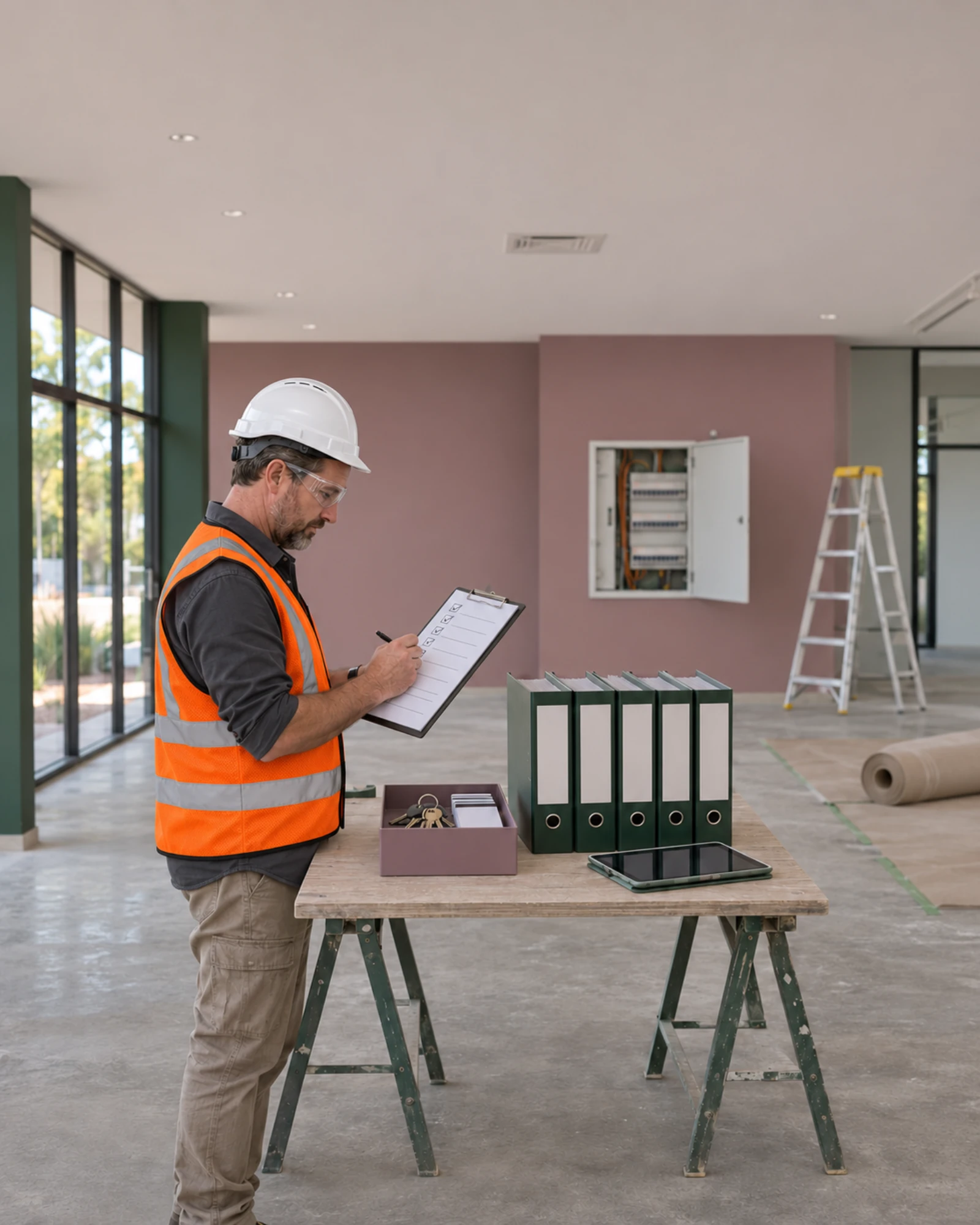
Practical completion is a fortnight away. The project manager who started the job moved on in autumn, and the one who took over has a folder of emails and a list from memory. The O&M manuals haven't arrived, two subcontractors still owe warranties, and the as-builts are a set of red pens on the construction drawings.
Everyone knew these were coming, but nobody had been given the job of collecting them.
What is construction project closeout?
Closeout is the stretch from practical completion to final completion. It covers handing over the work and its documentation, fixing defects during the defects liability period, and settling the final claim. Practical completion usually depends on certain documents being received, so closeout starts well before the last week.
Victorian Government guidance, for example, says a project reaches practical completion when the works are complete apart from minor defects that don't stop them being used, all commissioning tests have passed, and all certificates, warranties, guarantees and operational manuals have been received. The defects liability period follows, usually twelve months, and final completion comes at its end. Your own contract sets the exact requirements.
What goes on a construction project closeout checklist?
Every document the contract asks for at practical completion and at final completion, plus the internal steps to close the job. Most lists start with these.
| Item | Who usually provides it | When it can be collected |
|---|---|---|
| As-builts | Your team, plus each subcontractor for their work | As each section is finished |
| O&M manuals | Subcontractors and suppliers of installed equipment | Once equipment is installed and commissioned |
| Warranties and guarantees | Subcontractors and suppliers | When the work or product is complete |
| Test and commissioning records | Your team and specialist subcontractors | As each system is tested |
| ITPs and quality records | Your team | Closed out as each lot is accepted |
| Certificates of inspection and compliance | Certifiers and licensed trades | As each inspection is passed |
| Defects list or punch list, signed off | Your team with the client or superintendent | At practical completion, then through the defects liability period |
| Final claim | Your team | At the end of the defects liability period |
Add anything your contract or specification names, such as keys, access cards or spare parts.
Why does closeout fall apart?
In my project and contract management work, project closeout was where documentation most often fell apart. On longer projects the role could pass between several project managers, and whoever was in the seat at practical completion inherited the job of chasing every outstanding item at the last minute. Without a defined closeout process it became a scramble.
The documents themselves are rarely hard to get. They're hard to get all at once, from subcontractors who've moved to other jobs, months after the work they relate to.
How do you build closeout into the job from the start?
Start the checklist in the first week and keep it as a register through the job.
- Build the checklist from the contract at the start of the job, using the handover requirements in the contract and specification.
- Give every item an owner, including which subcontractor provides it.
- Collect as you go. As-builts, test records and warranties come in as each section finishes.
- Keep one handover folder with the current revision of each item, and nothing superseded mixed in.
- Review the register at each site meeting from about two thirds of the way through, so the gaps show while there's time to close them.
When the project manager changes, the register goes with the job, so the next person starts from a list instead of a folder of emails.
Where can AI help with closeout?
AI can compare what you've received against the checklist and show the gaps. A Project in ChatGPT or Claude is a workspace inside the tool where you keep files, so the AI can read your checklist and the handover folder together. For more on where AI fits on a contractor's job, see using AI in construction.
| AI gets ready | You check and decide |
|---|---|
| A checklist drafted from the handover clauses in your contract and specification | Whether the list is complete and right for this job |
| A comparison of the handover folder against the checklist, showing what's received, missing or out of date | Whether each received document is the right one |
| Draft follow-up emails to subcontractors for their outstanding items | What you send and when |
| A short status summary for the site meeting | What goes in the minutes |
What should you still check yourself?
Whether each document is accurate and complete. AI can see that an O&M manual has arrived, but not whether it covers the equipment actually installed. It can see a set of as-builts, but not whether they match what's in the ground.
What your contract needs for practical completion and for the final certificate, and when security or retention is released, are questions for your contract and your advisers.
If closeout only gets attention in the last fortnight, the list probably lives in one project manager's head and leaves with them. That's the part worth sorting first, before any tool. Once the checklist and its register are in place, AI can have the gaps listed and the follow-up emails drafted for you to check, and you still decide what's handed over. If you'd like to talk through how your jobs close out now, book a free 20-minute call and I'll tell you honestly whether AI fits.
Quick answers
What documents are needed at project closeout?
It depends on the contract, but most closeouts include as-builts, O&M manuals, warranties, test and commissioning records, certificates of inspection and a signed-off defects list. Check your contract and specification for the full list.
What's the difference between practical completion and final completion?
Practical completion is when the work is complete apart from minor defects and can be used. Final completion comes at the end of the defects liability period, after a final inspection, and closes out the contract.
What is a defects liability period?
It's the period after practical completion when the contractor returns to fix defects in their work. It's usually twelve months, and your contract sets the exact length.
About Kylie. Kylie Gillin spent twenty years in project and contract management before starting her AI consultancy for trade and civil contractors. She helps owners get the business out of their heads and into systems their team can run with.
Last reviewed 27 November 2026
Sources
- Victorian Government, Managing the project after practical completion (updated September 2024)
- Standards Australia, Standards Australia updates AS 4000:2025 General Conditions of Contract (June 2025)
- OpenAI Help Center, Projects in ChatGPT, and Anthropic, What are projects?, as at November 2026