The agreed work, built and handed over working.
Some builds come out of a strategy review, where the plan sets out what is worth changing and in what order. Others start with a clear brief, like a dashboard, a website or company materials, and come straight to me. Either way, I build it around how your business already runs, with the points where you check, approve or decide built in, and you know the price before anything starts.

Two ways to start.
It depends on whether you already know what you want built.
For AI tools and automations. The review works out what is worth building and in what order, so the build fits how your work runs.
For a dashboard, a website or company materials like presentations and proposals. If you know what you want, it can go straight to scoping.
From the plan to a working build.
Whichever way it starts, every build goes through the same steps.
- Where it startsYour plan or brief
The written plan from your review, or a clear brief of what you want.
- Step oneThe scope
What gets built, what it works from and where a person decides, written down and agreed.
- Step twoYour fixed quote
One price that includes testing and handover, agreed before any work starts.
- Step threeThe build
Built around how your work already runs, and tested before it reaches you.
- Step fourHandover
It's handed over working, and the decisions stay with you and your team.
Where the example plan goes next.
The strategy review page shows a plan for a made-up electrical business. Its last step was to get the build quoted for the draft quotes. Here is a build that came out of a review, from there to handover.
Coastline Electrical
Owner and four electricians. Quotes written by the owner after hours.
From their plan, step three. Get the build quoted for the draft quotes.
The scope
Works from the last twenty quotesAgreedThe folder the owner gathered in step one of the plan.The owner checks every figureYou decideSettled in step two of the plan, so it's built in as the last step before a quote goes out.Safety documents for each siteNot this buildHeld for later, as the plan said, until the builder's own system is checked.The fixed quote
One price for the draft quotes, including testing and handover, agreed in writing before work starts.
Handed over
A draft quote, ready to checkWorkingPast prices and scope from similar jobs are already pulled together, so the owner's part is checking the figures and sending it.
An example only. Every scope is built from your own plan.
What can be built.
Built around how you work, so you're not bending your business to fit software made for everyone.
Quotes, forms and project documents drafted from what you already hold, ready for a person to check.
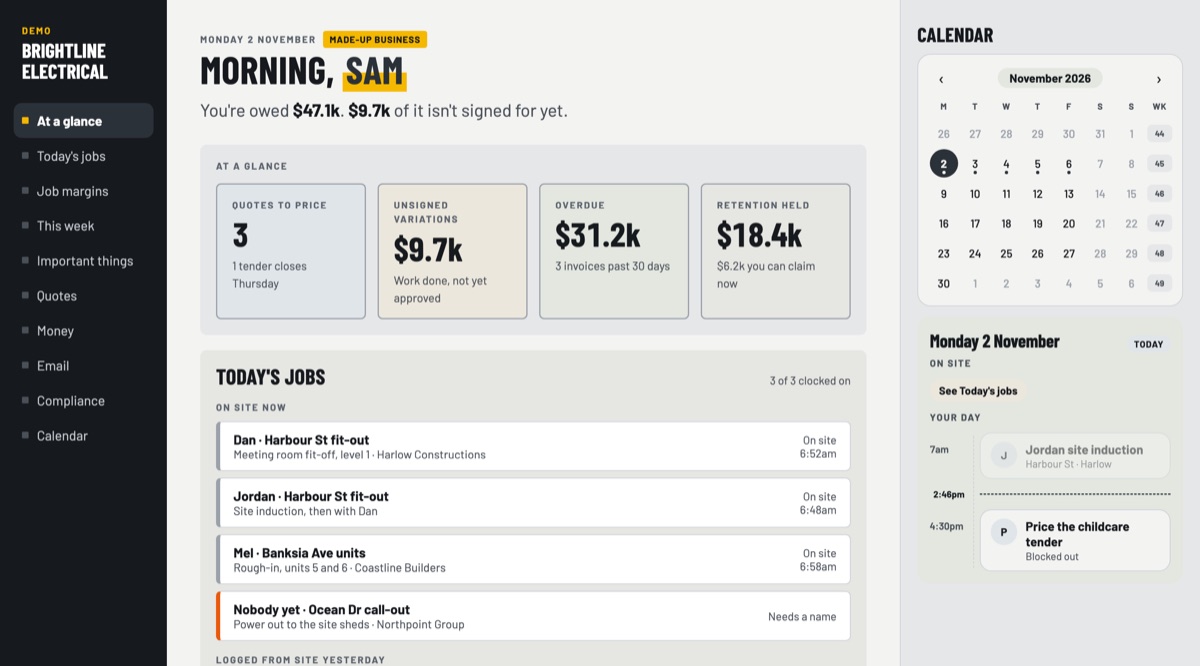
One page that shows where your jobs, quotes and claims are up to, so you can see what needs you.
Information moved between the tools you already use, so it's ready for whoever has to act on it.
A website, presentations or proposals in your own branding, from a clear brief.
“Kylie quickly delivered a clear process map and working prototype that quantified the opportunity and showed a concrete path to free our team from repetitive tasks.”
Questions about implementation.
What exactly is included?
A written scope, a fixed quote, the build, testing and handover. The scope sets out what is built, what it works from and where a person checks, approves or decides, and it's agreed in writing before any work starts.
Do I need a strategy review first?
Not always. A dashboard, a website or company materials with a clear brief can come straight to scoping. For an AI tool or automation, the review comes first, because that is where the purpose and order get agreed, so the build fits how your work runs.
Why is there no starting price?
Some builds are small and some are large, so one starting price would mislead you either way. You get a fixed quote, including testing and handover, before anything starts.
What if it isn't clear whether it can be done?
Then it needs more research than the review covers. Paid scoping is a separate $750 step, credited towards the build.
How long does a build take?
It depends on the build. The timeframe is set during scoping, once I know how complex it is.
Who makes the decisions?
You do. The scope sets out where a person checks, approves or decides, and those points are built into the workflow.
Do you set up our IT?
No. Setup, access and approvals stay with you. Some portals and software may also limit what can be connected, which I'd confirm during scoping.
Can you tell us what to put in our tenders or SWMS?
No. You and your advisers decide what goes in your tenders, SWMS, claims and variations. I make the process around them more efficient, and I don't give legal, safety or tender advice.
Can a build guarantee a submission is complete?
No. It can help check the required parts are there, to a certain degree, and you check it before it goes out.
Ready to get it built?
Tell me which step of your plan you'd like built, or what you have in mind, and I'll come back to you about scoping.
Discuss a projectFixed quote after scoping. Not sure what you need yet? Start with the strategy review.