AI strategy review
Strategy before any systems or AI tools. You finish with a written plan for where your hours are going across quotes, tenders, claims and project documents, and what to change, in order.
I build AI systems around how your business runs, so you and your team spend less time on tender submissions, quotes, claims and project documentation.
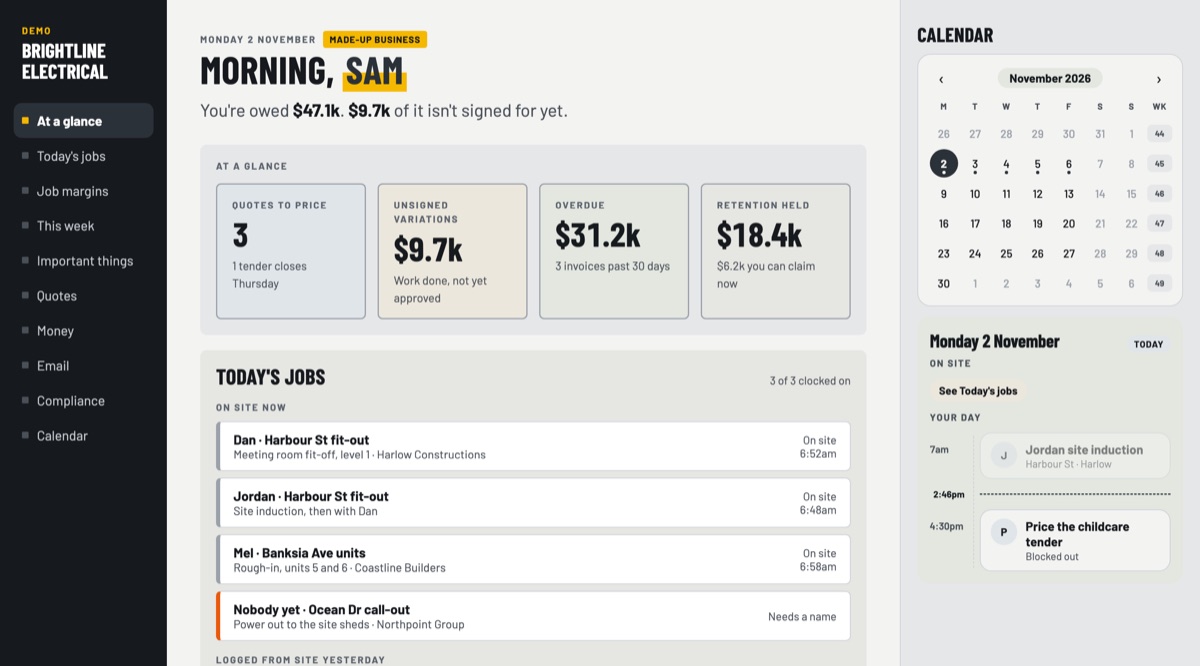
The jobs, quotes, money and documentation you check every morning, all on one dashboard, so you're not bending your business to fit software made for everyone. It's for a made-up electrical business.
See the work dashboardMost small contractors have more to do than people to do it.
Past tenders, company details and project examples are ready to go in a first draft. You decide what goes in, and your time goes on deciding what to go after.
Quotes from suppliers, builder approvals and overdue documents are tracked in one place, with follow-ups drafted and ready to go. You check them, send them and get back to thinking about the work.
Registers, project documents and monthly reports are prepared from what's already been recorded on the job. You check what matters, and your time goes on the job.
How you price, quote and run jobs gets written down where the team can find it. The work keeps moving when they're away, and you get more life outside work.
I'm a project manager and I run my own small business, so I've seen this from both sides. On projects, it's chasing people and staying on top of the documents, while making sure everything comes in on time, on budget and within scope. In my own business, it's the admin that keeps taking me away from the higher-value work. I build systems that prepare the repetitive work, so you can focus on the parts that need you.
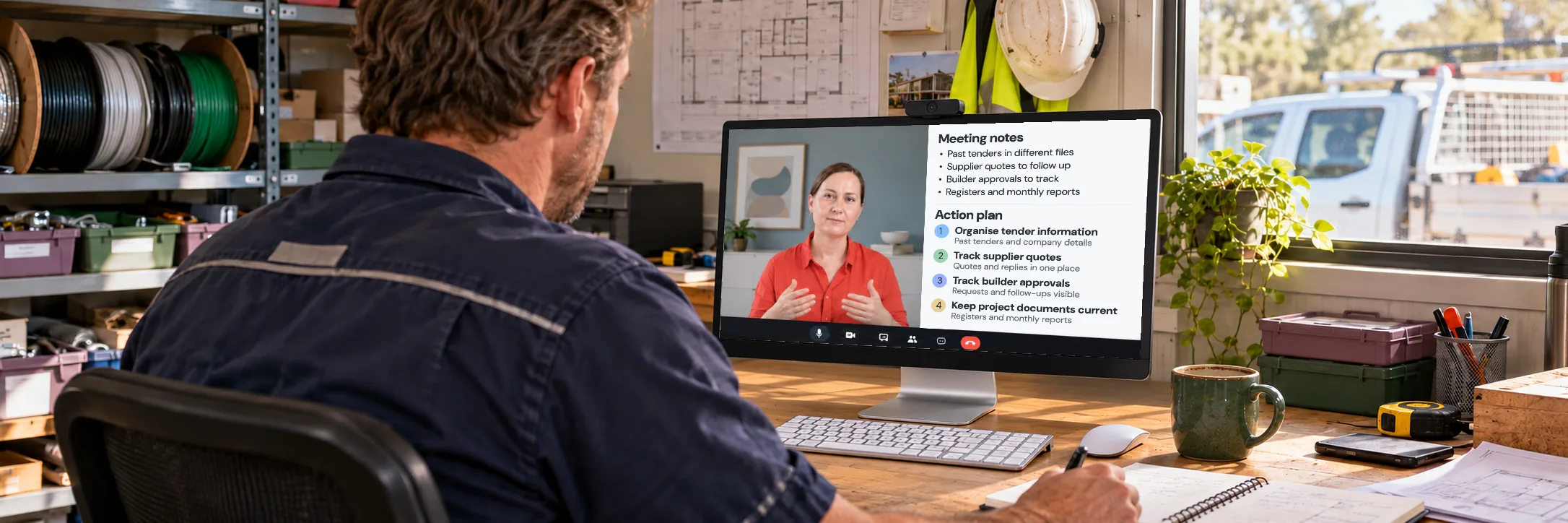
I look at your processes to see where AI can fit before anything gets built. Then AI can fit in one of five ways. Go through the steps to see each one, using a tender as the example.
Ask AI to pull out the requirements, dates and returnable documents from the tender pack, so you can see what's needed before you start.
Most paths start with the same free 20-minute call on how your work runs now. Where it goes after that depends on what the work actually needs.
Strategy before any systems or AI tools. You finish with a written plan for where your hours are going across quotes, tenders, claims and project documents, and what to change, in order.
The agreed work, built and handed over running. An AI tool, a reusable skill, an automation or a website, with the scope written down and a fixed quote first, testing and handover included.
Your team leaves using AI on their own work, not watching a demonstration of someone else's. A half or full day, online or in person, built around the documentation they handle each week.
You and your advisers decide what goes in your tenders, SWMS, claims and variations. I make the process around them more efficient. I don't give legal, safety or tender advice.
After the work, I ask each client what they did with the time they got back.

$26,000 a year of staff time, mapped.
A working prototype, and a clear path to more room for the team's higher-value work.
“As COO, I engaged Kylie to assess and prototype automation for a daily workflow that currently costs us roughly $26,000 per year in staff time. Using Claude, she quickly delivered a clear process map and working prototype that quantified the opportunity and showed a concrete path to free our team from repetitive tasks so we can focus on higher-value priorities. Highly recommend Kylie, she was fast to understand the business, asked the right questions, and made a complicated space easy to understand while helping educate me along the way. Cannot recommend her enough.”
Katie McIntyre, COO, FORM

Hours of data entry cut.
More room for budgeting, forward planning and managing the business, and for me personally too.
“Kylie's Claude workshop was one of the best-structured sessions I've done. Clear, visual, and easy to follow even for a non-technical audience. I went in wanting to reduce mundane data entry for my finance team, and I've already built live-linking systems that sync directly to our accounting software. That's freed up real time for higher-value work: budgeting, forward planning, managing the business, and, honestly, for me personally too. Highly recommend if you want practical, applicable AI skills, not just theory.”
Maxine, Finance Director, Consensio Chalets

Around 10 hours back every week.
More room for building her app, Already Her.
“After just one session with Kylie, I learned how to properly instruct Claude and build skills that make it work more effectively for me. Kylie's approach was so easy to follow that, even as a very non-technical person, I could put what I learned into practice straight away. She took something I found daunting and made it feel simple. I no longer have to repeat myself or re-explain what I'm looking for, because Claude just gets me. It saves me around 10 hours a week, and I can now focus my attention on my app, Already Her.”
Ursula, Already Her
Before AI, in contract management
It saved weeks of work on each scope, and clearer scopes meant fewer variations. I bring the same thinking to AI now, starting with how the work should run.
More systems I built before AI
Kylie Gillin
Twenty years in project and contract management, across power utilities, electrical contracting, commercial construction and engineering consulting, and a business of my own built in the hours around a full-time job. That is where I learned what AI is genuinely good for, and what it is not. The strategy comes first, and the tools are built around it.
You don't need to know what AI can do. Talk me through where your hours go, and I'll tell you honestly where AI can help. If it can't, I'll say so.
Work with meFree · 20 minutes.